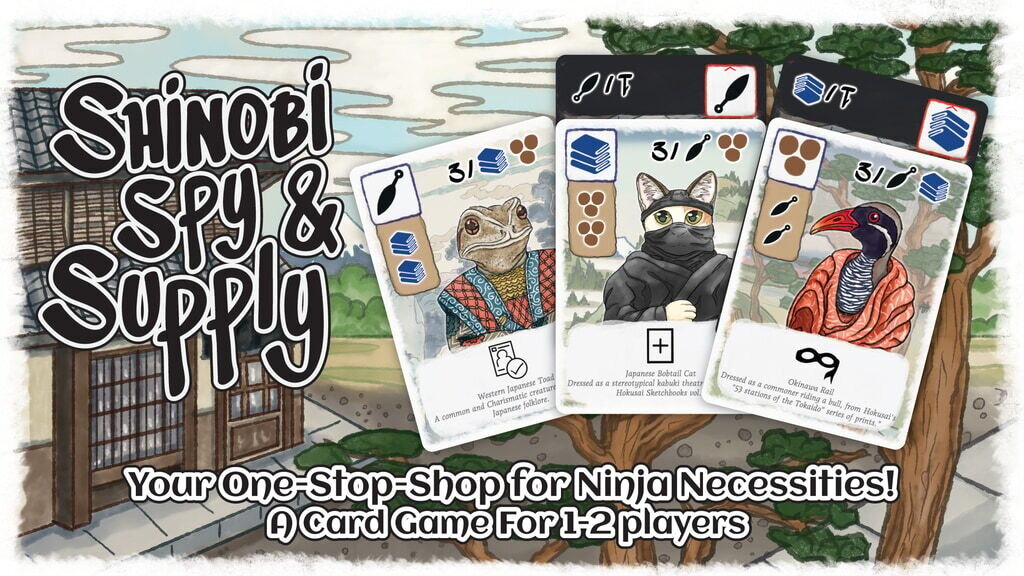
Sell the Shinobi (Ninja) clientele all of the supplies they need in this Micro card game of set collection and sabotage.
Latest Updates from Our Project:
Last stretch goal reached!! Surprise freebie, poll results, collabs!
4 months ago
– Tue, Jun 02, 2026 at 01:21:19 PM
In this Update: Stretch goals, free surprise printable, poll results, collabs, and Micro May Shoutouts!
All Stretch Goals Unlocked!!
Our final stretch goal is now unlocked!! Thank you all so much for supporting our game! The promo card pack will now have all 4 cards printed!! This includes the Orca, Kappa, Gull, and Lidth's Jay! All characters are available in the PNP as well.
None of these cards contain gameplay changes; they’re fun alternative art for the starting shopkeepers. They're also nice for the 4 player "chaos" mode.
Final campaign Surprise!
Our final campaign surprise is a digital sticker sheet. Print these out on sticker paper to make Shinobi stickers at home!
Art Print Poll Results!
The Koi won the 3rd art print poll! I'm so excited to see these printed at a larger scale than card-sized :)
One last shoutout for Micro May Collabs!
I want to give one last shoutout to Flock & Squabble, Courage & Cunning, and Cryptid Creek, our official collaborators for Micro May 2026! Check out their games for Leslie's art and fun exclusive promo cards!
Shinobi Spy & Supply also comes with promo cards featuring all of these games!!
(Note: late pledge isn't open for Cryptid creek yet, but it will be during the pledge manager)
Micro May Shoutout
In this update I'm also featuring one last Micro May project from another Minnesotan. I got to test this one at Protospiel Twin Cities last weekend, and had fun playing it!
REMIX will challenge you spell decisively while your opponent is also making plays in real time. Create legal words quickly to get rid of your deck before your opponents!
Thank you's
I'll save the big speech for after the campaign, but we're feeling very grateful here at Orca Island Games for the support you've given us to make Shinobi Spy & Supply a reality. Thank you all <3
-Leslie
Stretch Goal Unlocked! New Poll, Solo Video, Micro May, Art Blog
4 months ago
– Mon, May 25, 2026 at 12:25:51 PM
In this Update: we've reached the $5,000 stretch goal! What's next, poll results and new art print poll, Solo mode video, Micro May, and more Art Blog.
Stretch Goal Unlocked!
We've unlocked the $5,000 stretch goal and unlocked upgraded cardstock quality for the cards!! Thank you all so much, we're so excited to have made it this far!!
I'm in discussions with my manufacturer to discuss which nicer cardstock is the right option for us, but regardless we're very excited to have reached this milestone and make the games even better quality than before! Thank you!!
New stretch goal added!
We've decided to add one new stretch goal for the remainder of the campaign. If we reach $6,000, BOTH Print-And-Play-Only promo cards will be printed with the original Orca and Kappa (From Cryptid Creek) promos! This makes a total of 4 promo cards for the game!
This includes the Guest Artist promo card, the Black-Tailed Seagull by Shane Tholen of Flock N' Squabble, and the Lidth's Jay promo card (Illustrated by Leslie Kolke) from Courage & Cunning!
If we don't reach the stretch goal, both characters will still be printable by anyone at home!
Art Print Poll Results
The Shiba Inu won our last art print poll, by a hair! It will join the red fox in the Art Print pack add-on (also included in the "Everything Shinobi Spy & Supply tier).
Last Art Print Poll!
With the final week-ish of the campaign approaching, the last art print poll is up! Vote for your favorite character in the Cloth resource suit.
Solo Video Playthrough (Standard difficulty)
The solo video is live! Check it out to learn how to play and watch me beat up the standard difficulty AI Shopkeeper.
(To clarify, it's not generative AI, just an automated opponent)
Micro May Shoutouts
A Quick mini shoutout! Our Collaborator project, Cryptid Creek, is ending soon! Check it out for more of Leslie's art and exclusive promos!
Each of the 18 games in One Card Wonders follows the same basic principle — the rules and the game itself are contained within just one card. This way you don't have to look for a separate rules sheet when pulling out one of the games, because they're right there on the same card!
Most of the games require just a few simple components to play, like dice or coins, and some are even playable with the card alone. Each game's rules specify which components are needed to play it, and all are included in the box!
Epic, Funky, or Smart? Vote as Aliens and find the Human in this social deduction party game for up to 8 players.
We are aliens returning home after gathering many things, and possibly a human or two, from our first visit to Earth. We must vote on what we have found and discover who might be a human posing as one of us.
Launching this week!!
Micro May is finishing strong with another wave of great games! Follow these to be notified when they launch!
Counterpoint invites players to experience the world of classical chamber music through cooperative trick-taking. Take on the role of an adorable classical musician, play your part by collecting your own suit, and navigate through increasingly complex real-life classical chamber music compositions.
Bananarchy is a fast paced party card game for 3 - 8 people where players don't have to wait their turn to play!
Scramble to collect the most points in Bananas before the Banana Grove is empty. Outmaneuver your opponents with clever distractions, ripening agents, and all out monkey mayhem to be crowned the Monkey King!
Art Blog #5, Sika Deer
The name Sika deer is derived from “Shika,” (鹿) the Japanese word for deer. They are beautiful creatures, being one of the few deer species to retain their spots into adulthood (although populations differ, some having very faded or no spots). Because of their beauty, they’ve been introduced to many places around the world, and have become an invasive species in some of those places. Conversely, they’re endangered or extinct in some of their native range, although still prevalent in Japan.
The deer are best known in Japan for their presence in Nara, where they have been fed and protected by humans for centuries. In Shintoism, and in Nara in particular, the deer are thought of as "Messengers of the Gods," referring to the founding story of Kasugataisha Shrine, where a white deer arrived from Kashima Shrine as a divine messenger.
Today, when visiting Nara, you can buy “deer biscuits” to feed the deer, made of rice bran and wheat flour. The officials ask visitors to not pet them and be wary of male deer with antlers, as they are still wild animals.
Art Institute of Chicago's information on this print: (Link)
This print is Utagawa Kunisada’s “Memorial Portrait of Utagawa Hiroshige”, from 1858. Utagawa Hiroshige was an extremely prolific master of Ukiyo-e printmaking, specializing in landscapes. After being orphaned at age 12, he started training under Utagawa Toyohiro, of the Utagawa school of printmaking. He created 8,000 pieces over his lifetime. Despite having been paid little for many of his prints, he was extremely dedicated to his craft, having become a buddhist monk towards the end of his life to help complete his One Hundred Famous views of Edo series of prints. His style was partially influenced by Katsushika Hokusai, who also painted many landscapes. Both artists’ works were in turn very influential to the impressionists and post-impressionists of Europe, who collected their pieces and were inspired by them.
This portrait of Hiroshige was made by Utagawa Kunisada, in the year of Hiroshige’s death. The two were documented as being friends. Kunisada was a much more popular artist in their time, so to help Hiroshige promote his “The Fifty-three Stations of the Tōkaidō” series of prints (to this day some of his best-known works), Kunisada created his own The Fifty-three Stations of the Tōkaidō series, featuring Hiroshige’s landscapes with one of his (Kunisada’s) portraits in the foreground.
(Above: "The Fifty-three Stations of the Tokaido." Portrait of kabuki actor Onoe Kikugoro III in the role of Tokuzo. From Kunisada's 1852 series helping to promote Hiroshige's work. Wikimedia Commons)
Hiroshige's memorial portrait is surrounded by an account of Hiroshige’s life written by another good friend, writer Tenmei Rojin. At the end is Hiroshige’s “farewell poem:” “Dropping my brush in Azuma [Edo], I go the long journey to the western country [paradise] to view there the wonderful scenery.”
I wasn’t expecting my research to lead to the story of close friendships between these artists from ~170 years ago, but it touched my heart to find through the memorial portrait how much Utagawa Hiroshige was cared about by his friends.
Stretch Goal Unlocked! + Micro May, New Collab, Weekly Surprise, Art Blog
5 months ago
– Mon, May 18, 2026 at 01:42:10 PM
In this Update: stretch goal unlocked, a fun surprise, Micro May Collabs, Micro May Artist Spotlight, and more Art Blog!
Stretch Goal Unlocked!!
We've unlocked the $4,000 stretch goal!! Thank you all so much for your support! Every pledge will now have access to a printable 3-4 player "Chaos" mode, complete with the mode's instructions and scoresheet!
Only one copy of Shinobi Spy & Supply is required to play, but we recommend players be somewhat familiar with how the game plays at 1-2 before playing at 3-4 players (I did say it's chaotic, haha).
Our next stretch goal will be upgraded card stock thickness, at $5,000! It's amazing we've made it this far, thank you for helping make this game a reality!!
New Surprise Upgrade!
It's a new week of the Kickstarter, and I have another surprise! The Print and Play (included in all tiers) will have a low-color black and white version in addition to the normal game!
If you want to save on ink or want to color in all of the characters yourself, you'll be able to! Available in 2 print formats: A4 & Letter size.
Flock and Squabble is a fast moving, family friendly card game where players slam their seagulls onto a table piled with rubbish. The player who swoops with the most seagulls, wins the pile!
The play table is the beach. There is a common pile of beach rubbish building up between you. You have a deck of seagulls with various values, and you have 5 of these in your hand: You will use these to 'bid' on the piles. On your turn, flip from the main deck and match symbols to make larger piles of rubbish. That's calm and quiet. But, as soon as you flip a purple seagull, all players slam their bids onto the pile they want. The fastest adds the purple seagull to their bid. The highest bid on a pile wins all that rubbish (and the health points therein). But be clever: You use up the seagulls you bid. You only have 16 cards. There are 10 purple seagulls. That's 10 'playoffs'. If you send too many seagulls too early, there won't be enough seagulls to snatch up the tasty morsels at the end.
Shinobi Spy & Supply is Collaborating with Flock N' Squabble! The PNP of our game has a guest artist card illustrated by Shane Tholen, and Flock N' Squabble has Leslie's guest artist card of an Australian Sea Lion!
Launching Tomorrow as part of Micro May! Follow/Presave today!
Announcing A New Collaboration with Courage & Cunning by Fountain Mouse Games!
I designed this collab character, named Jaylith! Jaylith is a Lidth's Jay, and will appear as a character in both games! (Print and PNP versions for Courage & Cunning, PNP only for Shinobi Spy & Supply)
Behind the Mechanics of Shinobi Spy & Supply with PNP Time!
Check out this newsletter article where I discuss how we created and developed Shinobi Spy & Supply!
Micro May Artist Spotlight Flipbook:
Check out this flipbook put together by the lovely Nicole Fende of Mayhem and Delight Games, featuring some of the art and artists of Micro May 2026!
Art Blog #4
The Japanese giant salamander (Andrias japonicus) is the 3rd largest salamander in the world, reaching 5 feet (1.5 m) in length and 55 lbs (25 kg). It is one of only 6 giant salamander species in the world. In Japanese it’s called ōsanshōuo (オオサンショウウオ/大山椒魚), which literally means "giant salamander," or hanzaki (鯢魚 / はんざき), referencing it’s folkloric ability to regenerate itself, even after being cut in half.
Photo by the Smithsonian National Zoo, CC0 Public Domain (Check out that link, it has videos and more!)
It’s a fully aquatic salamander that lives in southwestern Japan, typically found in fast-flowing mountain streams. They migrate throughout their lives between tributaries and the main river. Although they lose their gills when they undergo metamorphosis like most salamanders, they remain fully aquatic and raise their heads above the water to breathe air. They also absorb oxygen through their skin, and are well adapted to do so by having many skin folds to increase surface area.
"Hanagami Danjo no jo Arakage fighting a giant salamander," by Utagawa Kuniyoshi, Public domain, via Wikimedia Commons
In folklore they are often depicted as giant monsters who can regenerate themselves and swallow people whole. They do have amazing regenerative capabilities, being able to regrow limbs if necessary. Unlike in folklore, however, they're slow moving and not dangerous in the least.
Much is being done to help with their conservation, but they still face threats of pollution (due to breathing through their skin), and habitat fragmentation and loss.
Okitsu, from the series "Fifty-three Stations of the Tokaido (Tokaido gojusan tsugi)", by Katsushika Hokusai, In the Art Institute of Chicago's collection, CC0 Public Domain
This print is Okitsu, from the series Fifty-three Stations of the Tōkaidō (Tōkaidō gojusan tsugi), by Katsushika Hokusai in 1805-6. Shinobi Spy & Supply's giant salamander character is wearing one of these traveler's outfits.
Hokusai’s Fifty-three stations of the Tōkaidō road is not as well known as Utagawa Hiroshige’s series by the same name. Hiroshige’s series focuses on the landscapes that travelers saw on their journey, while Hokusai’s focus is on scenes between people at different places. The shift in focus makes Hokusai’s prints of the Tōkaidō feel, to me, more like the memories of a trip and the people that you take it with, rather than postcards that you buy when you’re there. Both are valuable, and I love how distinct the points of view are!
These travelers are at Okitsu-juku (興津宿), a town of roughly 1,668 people and the 17th station on the Tōkaidō road, established in 1601. It’s located in Shizuoka, in what is now part of the Shimizu Ward (Shimizu-ku), a harbor town known for Japanese mandarin oranges, green tea, love of football (soccer), and its fisheries.
That's all for this update! Thank you all for your support, we couldn't have made it this far without you. You've made Shinobi Spy & Supply a reality :)
Stretch Goal Unlocked! New Poll, Micro May, and Art Blog
5 months ago
– Thu, May 14, 2026 at 08:09:27 AM
We've hit the $3,000 stretch goal!! In this update: What's next, a new Art Print poll, more Micro May features, and more Art Blog.
Stretch Goal Unlocked!
The deluxe boxes will now have decals on the back and one side! This upgrade (in addition to being pretty) helps put the game on a shelf in a way that's easier to see the player count/play time.
(gold foil design not final)
The next stretch goal at $4,000 is a printable 3-4 player mode! We deemed it too chaotic to be included in the base game, but with this printable-at-home file included with all pledges, you can embrace the chaos yourself.
Last update, we also included surprise Printable bookmarks! Keep your eyes peeled, as we have more surprises in store for the coming weeks, unrelated to stretch goal content.
New Art Print Poll
The Japanese Red Fox (Vulpes vulpes japonica) won the last art print poll, and will be included as one of the 3 characters featured in the 5x7" art prints! I've opened a new poll for the next character set, the Kunai resource suit (and Tanuki starter character card).
Our God Is Dead is a comedy fantasy role-playing game where you play as clerics preparing for the divine festival of your god. There's only one problem... your god kicked the bucket last night and the entire city is still looking forward to the celebration.
Grab your friends and get ready to fake some miracles as you scramble to save face and keep the truth from coming out.
The game doesn't need a GM, can be learned in minutes, and doesn't require any prep. It's the perfect game when you want an easy one-shot and a bit of silliness.
Originally published 5 years ago, Our God Is Dead is back for a second printing with a new Mint Tin Edition as part of Kickstarter's Micro May!
What is Serpentine? How do you define it? 1. A Town in Western Australia 2. A Description of something with many bends (e.g. a river) 3. A Card-drafting mechanism (a.k.a. snake draft) 4. The name of this exciting new game inspired by the first three definitions above!
Art Blog #3, Behind the Scenes of the Art Process
My process for Shinobi Spy & Supply’s art can be broken into a few steps.
First, the Research Phase:
This phase often takes the longest. I look up creatures that are culturally important or unusual, and find good reference images for them. The clothing research is harder! Matching the historical print for the clothes to the creature sometimes has to do with backstory, sometimes with colors used, and sometimes just a gut feeling of being the right choice. In this case, I chose the serow for Hattori Hanzō, for a few reasons. Personally, I thought the serow’s neck fur resembles Hattori Hanzō’s facial hair, and it's also an animal that is historically revered and respected enough to represent Hanzō, in my opinion.
More information on Hattori Hanzō and the Japanese serow will be in the digital art book :)
(Both references Public Domain, CC0. Unknown artist for the portrait)
Sketch Phase:
Here’s where I work out the pose, how the clothes will fit on the creature character, what accessories to include, and how to size everything to match the rest of the illustration series. I sketch digitally over a basic head shape to help the size between illustrations be relatively consistent. Each animal gets cut off around the mid/bottom of the torso, so I don't need to draw past that.
Inking Phase:
Ink lines are where things start to feel real. For this project, I used a digital ink liner brush with a lot of texture, and I draw in Procreate (software).
There’s some weird things to keep in mind when making lineart for games. The illustrations will be printed small, so it’s important to zoom out frequently or step back away from my art so I can see how legible it will be when printed at scale. The thickness of lines needed to retain the correct visual weight and presence for the final illustration still surprises me sometimes.
Color phase:
I use layers of digital “watercolor” to create an authentic feel, making sure to include highlights and shadows. I’ll add details with various watercolor and textured brushes, depending on the look I’m going for for the illustration. When required, I do fine color linework with the ink brush again, but other texture brushes come in handy too. The details on the serow took a while due to the intricate samurai armor!
I still I have to remember throughout the process that it will end up being only 1.5" tall, so I prioritize which details are most important, as some will get lost when it's shrunk. Keeping the looseness of brushstrokes also helps maintain the watercolor-like nature of the finished illustration.
That's all for this update! Thank you for your support, we couldn't do it without you!
-Leslie
Week 1 Update! Surprise freebie, New review, Micro May features, and more Art Blog!
5 months ago
– Mon, May 11, 2026 at 12:12:09 PM
Thank you everyone for a great first week!
In this Update: a PNP Time review, week 1 surprise freebie, Micro May features, and learn about the history of the icons/resources featured in the game in Art Blog #2!
New Review From PNP Time!
The full PNP Time review of Shinobi Spy & Supply is out! Thank you to Tas for the in-depth feature! Check it out Here.
Surprise Freebie: Printable Shinobi Bookmarks!
Print these out to have Ninja hiding in your books! Get them Here.
This Fight Is Staged! is a cooperative strategy game for two players, played with two decks of playing cards. Work together with limited information to sequence your number cards correctly and impress the audience of face cards, and rise to meet the challenge of scoring enough for a gold star on every stage in the campaign mode!
Part of the zine game line of Triple Rainbow Games - small, handmade paper booklets that act as rulebooks and components for a variety of strategy games and other curios of joy. We provide the zines, you provide the rest of the components so you don't have to buy the same stuff over and over again, and we both win from our games being more accessible and affordable!
Your dying town needs tourists. Your solution? Invent a cryptid. Only one can win, but if the hoax is exposed, everyone loses.
In this competitive card game for 2-6 players, you'll bid on mismatched body parts from six eerie locations to craft your own legendary creature. Use your character's unique ability and deploy Smoke & Mirrors cards to outmaneuver opponents. But be careful! A reality TV crew is watching, and if the hoax meter gets too high, everyone fails together.
With strategic bidding, set collection, and storytelling moments when you claim your specimens, Cryptid Creek delivers tension, competition, and just enough chaos to keep everyone on edge. Can your town pull off the hoax of the century?
PLUS! We're collaborating with Cryptid Creek! The same Kappa Character is featured as promo cards in both games, illustrated by Leslie Kolke.
Kunai are an example of a weapon that can be easily concealed, easily acquired, and easily created. In reality, they aren’t usually weapons. Instead, they’re used as digging tools for farming or masonry trowels, which remind me of my own sharpened digging trowel. Kunai are often called “throwing knives” in popular media and used as such, when they would more likely be short range handheld weapons. Many shinobi no mono would have not carried many (or any) weapons, as their primary job during a mission would be to return with information or perform sabotage and not get caught, and thus not need a weapon. Despite this, we still have weapons as a resource in Shinobi Spy & Supply because they’re so intrinsic to Ninja legends, and I can’t imagine they weren’t important to some jobs.
Kikatsugan are a type of food for stealth missions, where one must stay silent and hidden for long periods of time. They’re made by fermenting a mixture of starches and traditional medicinal ingredients in sake for 3 entire years! The recipe can be found in the Bansenshukai, a book containing legends of the Iga and Kōka clans, who are deeply associated with ninja history and legends. The book has been called into question, however, as it was written over a period of centuries, often not by first-person accounts. Kikatsugan aren’t even the only type of “ninja energy ball.” Hyōrōgan are another energy ball and easier to make at home if you’re curious; due to the fact that they’re not horribly unpleasant to eat, don’t take 3 years to make, and are full of sugar!
*As a note, Tasting History probably shouldn't have used cooking sake because of the extra salt content. It's still a good informative video though!
Clothing was important for shinobi no mono, but not in the way many stereotypical myths depict. In order to sneak around in plain sight, shinobi must look unsuspicious, which meant dressing like the normal populace, or the class role they’re fulfilling. If trying to sneak at night, dark blue clothes may have been used, but the black ninja garb was a later creation that likely stemmed from the Edo period and became ubiquitous in the mid 1900s. It’s possible that the “ninja black” may have come from Edo period Kabuki theatre, where stagehands wore black to be less noticeable (not unlike theatre today). When a stagehand suddenly and dramatically reveals himself to be a secret ninja villain, he’s wearing black stagehand clothes! The clothes icon represents disguises for whichever job the shinobi need them for.
That's all for today! Thanks for reading, and extra thanks for supporting the game!